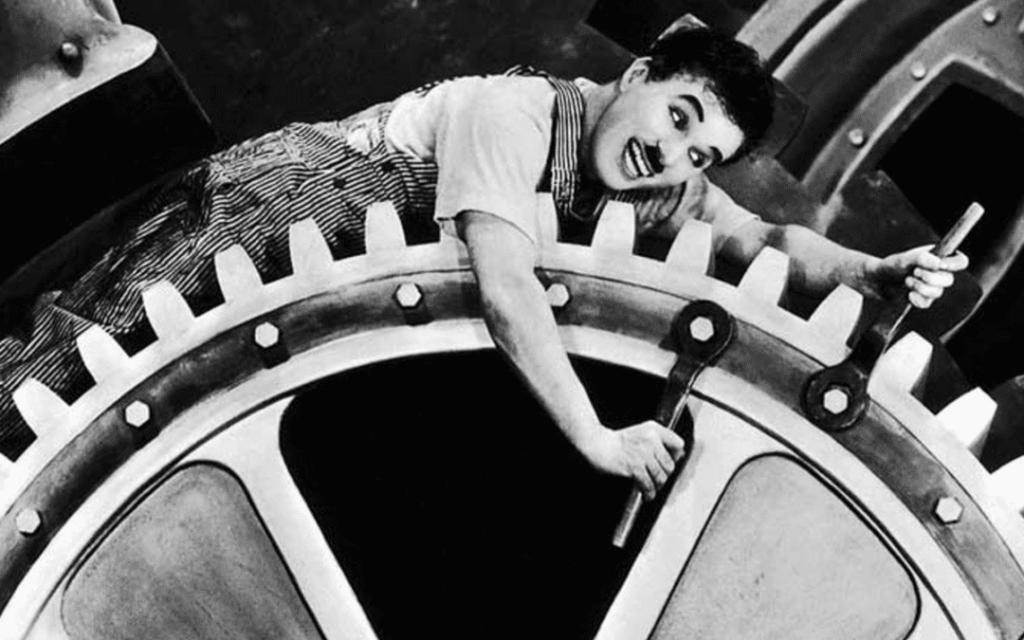


The politics of sound, shaped by the tortures of visual judgment, implicitly plays a crucial role in forming the spinal narrative of the 1936 film Modern Times. With a symphonic proportion of sixty-four musicians, Charlie Chaplin composed a musical saga of human “desire” and its fatal “destiny,” where the music positions the audience on an ambient platform, enabling them to become active agents and independent authors of their own experience. Thus, Chaplin begins with the note G, played at fortissimo, with a hint of vibrato. An unusual combination of F-augmented, beginning with the discordant G instead of the root note F, loses its tonal center and creates a disturbing effect. In all its amplification, the note places the audience in a fearful state. Through loudness and magnified dynamics, the trumpet resonates with the arrival of an ugly, monstrous giant. It marks the emergence of a powerful, dangerous, superhuman disciplinary force that holds power within itself. It is the power to destabilize the regular, rhythmic harmony of human life.
Fear of the unknown, or unfamiliarity with the new, introduces irregularity into the regularized motion of the everyday world. This unfamiliarity with the new order brings a change in motion to the lives of commoners in comparison to their previous state of existence. Thus, a non-rhythmic sequence of G, F, C#, and D#, played at fortissimo, screams out like an alarming voice, while the added vibrato trembles the audience’s bodily disposition, leaving them in utter chaos. This is how the blueprint of a newly emerging order is roughly introduced.
A sudden bass drum anvil strikes, as if hammering into our consciousness. Then the tune plays once again, this time slightly faster, reintroducing the same order and allowing us to recognize its rapidity. Now, two consecutive bass drum anvils are accompanied by the trumpet, oboe, and contrabassoon. Much like a Judge shouting “order, order” in a courtroom, the anvil hammers into our consciousness, forcing bodies to slowly accustom themselves to this newly introduced Order. This is the same tune Chaplin uses to orchestrate outrage among the unemployed, angry mob, or when the Tramp is sent to a mental asylum.
The clock represents a cycle meant to govern human lives for centuries to come. By switching between three or four different tunes in the main title scene, Chaplin encapsulates multiple modes of human emotion into a single cycle, assigning a constituent motion to each emotion. As the hand of the clock completes one cycle, the same set of tunes begins again, operating in constant repetition. It is as if human history is driven by a constant principle, with human “desire” acting as its chief architect. The first tune is succeeded by a chromatic tune when the clock covers a quarter of the cycle. This tune is played by transposing into various scales at respective intervals. Performed in an ascendo-descending manner, the chromatic tune reverberates the shivering state of mind and the perplexity of movement that characterize the Tramp’s struggle with an alien motive force constantly intruding into his life.
A herd of sheep and workers emerging from the subway and entering the factory is characterized by an A# minor-D# minor sequence, played by the cello and viola at 147 BPM. Following this sonic parade, as the workers enter the factory and assume their respective places of work, the background music dissolves into a mechanical hiss. Now, there are two or three things to be noticed. The worker walking toward the console and switching on the machine (the rhythm of his walk and the moment he pulls the trigger), the timing of the secretary placing a glass of water on the table, and the president taking his medicine–all these actions occur in synchrony with the rhythm of the background score at 147 BPM, but in complete silence. This is the motive force of industrial production, to whose motion every individual attunes himself. At 3:12 minutes, the rhythm escalates to 169 BPM as the speed of the machines is increased on the president’s instruction. The Tramp and the fellow worker constantly struggle to cope with this accelerating tempo. American music composer and conductor, Timothy Brock, notes, “the tempo grows to such a kinetic frenzy that much of the culminating section is nearly unplayable by humans. This merciless metronome […] intentionally set by Chaplin is so fragile–so on the very edge of collapse-that the listener is compelled to identify with the frantic Charlie on the verge of his mental breakdown” (1).
It is interesting to observe how Chaplin orchestrates the lunch-hour scene. It begins with an alarm and ends with an alarm. As soon as the first alarm rings at 1:04:09, the bassoon and viola enter a 4/4 staccato rhythm, playing an alternating sequence together at a strictly fixed tempo of 178 BPM. After a single bar, the flute enters with the chromatically sequenced tune, the second tune of the main title scene. Here, the tune moves slowly back and forth between C, B, A#, A, G#, and G in a reptilian manner, producing an insinuating imagery in its movement from one note to the next. The dense, thick lower-octave notes of the bassoon represent a fat, monstrous giant, while the thin, sharp, loud middle-octave notes of the viola represent a strict, legislative apparatus that keeps constant vigilance over the activities of the flute, representing Tramp. The Tramp, through the flute, chromatically insinuates from one note to another, exercising formal freedom while remaining restricted within pathways dictated by bassoon–cello synchrony. Together, these tunes represent master and labor, playing in disciplinary coordination under the agreement of a rhythmic contract.
Throughout the narrative, Chaplin’s music steadily increases in tempo, yet there is one tune in which rhythm disappears altogether. This tune recurs whenever the Tramp meets the Gamin after his release from prison, or when he manages to carve out a moment for himself to smoke. The tune cries out in the Tramp’s voice, mournfully celebrating his power to exercise freedom, the pleasure of breathing life into the soul, and the joy of practicing his own will against that of the master. However, this phase ends almost immediately. Chaplin orchestrates the final scene using the same tune, where the first shift between G-major and G-major-7th signifies a release of tension; a tension arising from oscillation between two different motions. The second shift, between A-minor and E-major, reverberates the fatal destiny of human desire, which is both free and fettered simultaneously. The third shift toward B-major characterizes suspension or a dissolution of desire toward an ultimate vanishing point, soon followed by a peaceful return to the key scale: G-major, accompanied by the root note G. This tune represents the human impulse to liberate itself from all rhythmic shackles.
As the tune gradually approaches its end, the trumpet joins in, amplifying the essence of humanity to a heightened intensity before striking G at fortissimo. The composition begins with G at fortissimo and ends on the same note, but at a higher octave. Yet, at the beginning, G was accompanied by F-augmented, whereas at the end, it was accompanied by G-major. By transitioning from F-augmented to G-major, Chaplin establishes tonal centrality. This tonal center, the root, may offer the audience a falsified sense of peaceful settlement, celebrating the magnanimity of humanity and its desire. The fear of, and unfamiliarity with, the new is now replaced by a desire for it. An octave, consisting of seven whole notes, is reached only after completing a cycle. Thus, when the trumpet strikes the same note with equal amplification but an octave higher, it suggests that wherever human civilization arrives, and whatever order it settles into, it is merely a manifestation of human desire, one that perpetually aspires to rise an octave higher than its own realization. In this way, Chaplin’s narrative, framed by its inaugural and concluding melodies, unfolds as a tautological allegory.